Identifying and Controlling Common Types of Aquarium Algae
James Thornton
Expert Contributor
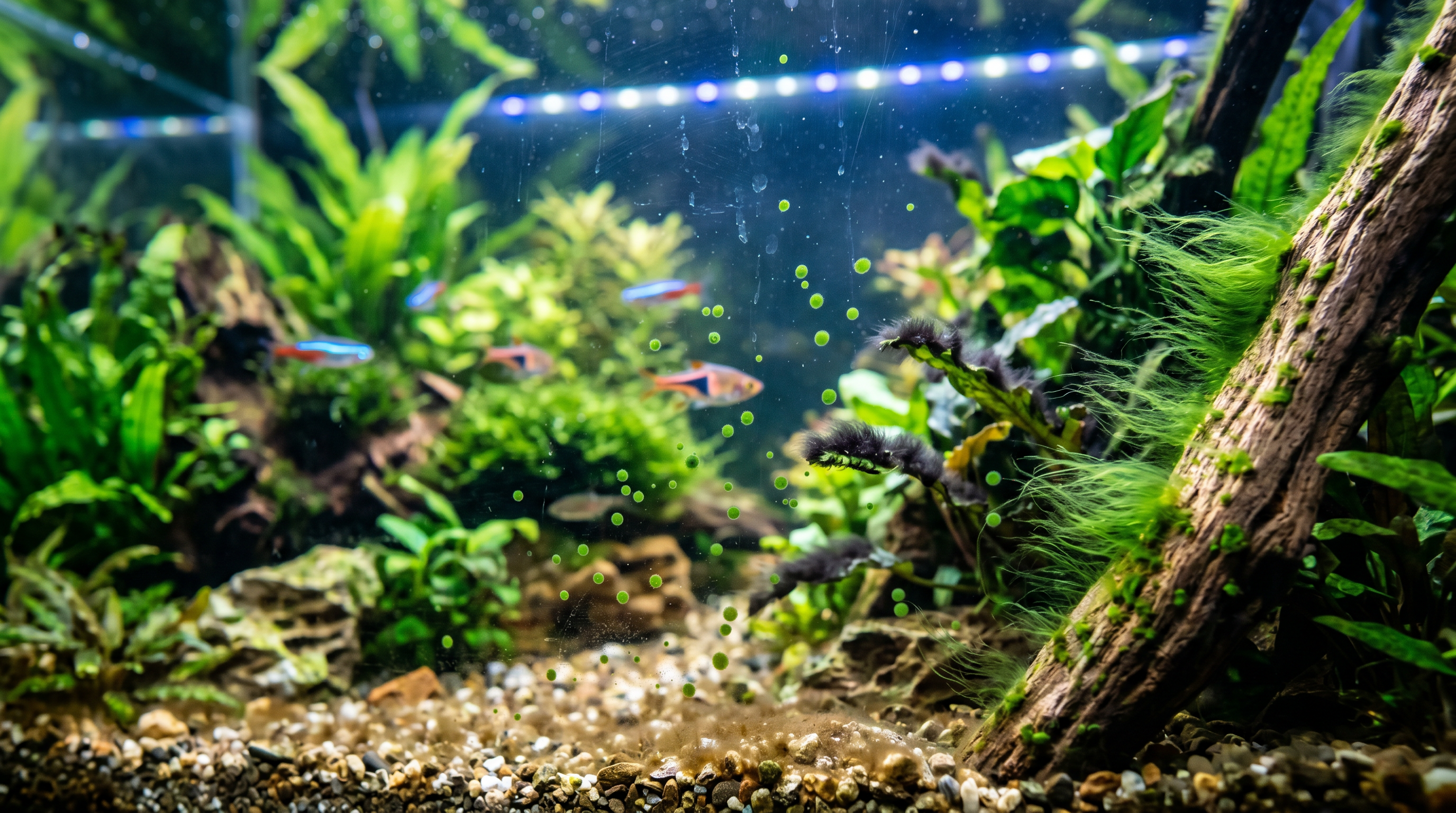
Every aquarist, from nervous beginner to seasoned reef keeper, has faced the same moment: you peer into your tank one morning and something green — or brown, or black, or slimy — has appeared overnight where it definitely wasn't yesterday. Algae. The universal adversary of the hobby.
But here's the truth that experience teaches you: algae is not your enemy. It is a symptom. Every outbreak is your tank sending you a message about an imbalance — too much light, too many nutrients, unstable CO2, or insufficient flow. Learn to read those messages, and you gain a powerful diagnostic tool. This guide will walk you through the six most common types of aquarium algae, how to identify each one with confidence, and exactly what to do to bring your tank back into balance.
Why Does Algae Grow in the First Place?
Algae, like all plants, needs three things to grow: light, CO2, and nutrients (primarily nitrogen compounds and phosphate). In a well-balanced aquarium, your live plants consume these resources faster than algae can exploit them. Problems arise when that balance tips — too much light for the plant mass you have, excess nutrients from overfeeding or a heavy bioload, or inconsistent CO2 that stresses your plants and leaves nutrients unused.
Algae is opportunistic. It thrives in the gaps your plants leave behind. This is why the long-term solution to almost every algae problem is not scrubbing harder — it is creating conditions where your plants outcompete algae for every available resource.
1. Green Spot Algae (GSA)
Green Spot Algae is one of the most common and most recognisable forms in planted tanks. It appears as small, hard, circular green discs pressed flat against the glass, decorations, and slow-growing plant leaves like Anubias. It does not wipe off easily — you will need an algae scraper or razor blade to remove it from glass, and it is virtually impossible to remove from leaves without damaging them.
GSA is almost always a phosphate deficiency problem. This surprises many aquarists who assume algae means too many nutrients, not too few. When phosphate levels drop below roughly 0.5 ppm, GSA takes hold. The fix is to raise your phosphate slightly — through a phosphate supplement, reducing water change frequency temporarily, or increasing feeding. Test your phosphate before making changes. In tanks without CO2 injection, GSA can also indicate the glass simply isn't cleaned frequently enough; a weekly wipe with a magnetic scraper is your best prevention.
2. Hair Algae and Thread Algae (Green Hair Algae)
Green Hair Algae (GHA) is the stringy, wispy green growth that drapes over plants, driftwood, and hardscape like fine green fur. In its early stages it is almost pretty — delicate threads catching the light. Left unchecked it becomes a dense, suffocating mat that smothers everything beneath it.
The cause is almost always excess light combined with elevated nutrients, often appearing in new tanks before plants are established, or in tanks where the light period is too long. The single most effective first step is reducing your photoperiod. If you are running 10 hours, drop to 6-7 hours for two weeks. You will be amazed at the results. Simultaneously, introduce fast-growing stem plants like Hornwort, Hygrophila, or Water Sprite to compete aggressively for nutrients.
For livestock-based control, Amano Shrimp are the gold standard. A group of 10-20 in a medium-sized tank will graze GHA relentlessly and efficiently. Nerite snails also help on hard surfaces. Avoid the temptation to manually remove all the algae at once — pull out what you can by hand (twirling it around a toothbrush works well), but combine this with fixing the root cause, or it will be back within days.
3. Black Beard Algae (BBA)
Black Beard Algae — also called Brush Algae — is the one that makes experienced aquarists groan. It appears as dense, dark grey-to-black tufts, usually 3-10mm long, growing on plant leaf edges, driftwood, filter intakes, and heater tubes. It has a velvety, almost fur-like texture and grips its substrate with remarkable tenacity.
BBA is primarily caused by inconsistent CO2. In injected CO2 tanks, fluctuating CO2 levels — whether from an inconsistent regulator, the CO2 turning on and off with the lights, or poor diffusion — create the perfect conditions for BBA. It is far less common in stable low-tech tanks. The fix is to stabilise your CO2: ensure your regulator holds consistent pressure, use a drop checker to target the appropriate CO2 range (usually a lime-green colour in the checker), and make sure CO2 is on for an hour before your lights come on.
Spot treatment with liquid carbon (glutaraldehyde) is extremely effective against BBA. Dilute it 1:3 with tank water and apply it directly to affected areas with a syringe or brush, with the filter turned off for 5-10 minutes. The algae will turn red-pink within 24 hours as it dies — at which point Amano shrimp will eat it enthusiastically. Repeat weekly as needed. Some aquarists also have success with Siamese Algae Eaters (the true SAE, Crossocheilus oblongus), though they can become lazy as they grow larger.
4. Brown Algae (Diatoms)
Brown Algae — technically diatoms — is the thin, dusty brown coating that covers glass, substrate, decorations, and plant leaves in new aquariums. It wipes off easily (frustratingly easily — it smears before coming off), and it turns everything an uninspiring murky brown. It is extremely common in tanks that are less than 8-12 weeks old, or in tanks that have recently been re-scaped.
The good news: diatoms are almost always a temporary phase that resolves on its own as the tank matures. They thrive on silicates, which are present in high concentrations in new substrates and tap water, and which naturally diminish over time. Consistent water changes and a good clean-up crew will see you through. Otocinclus catfish are phenomenal at grazing diatoms from glass and plant leaves — a small group of 4-6 is one of the best investments in a new planted tank. Nerite snails are equally effective.
If diatoms persist beyond 3-4 months in an established tank, test for silicates and consider using a silicate-absorbing resin in your filter. Also check that your tank is receiving sufficient light — brown algae often persists in tanks that are too dimly lit for the plants to thrive.
5. Blue-Green Algae (Cyanobacteria)
Despite the name, Blue-Green Algae is not actually algae — it is cyanobacteria, a form of photosynthetic bacteria. But it behaves like algae from the aquarist's perspective, and it is one of the most alarming outbreaks to deal with because it spreads fast and has a distinctive foul smell.
It appears as a vivid blue-green, red, or brownish slimy film that blankets substrate and plant leaves. It peels away in sheets and has a musty, unpleasant odour. It is most common in tanks with poor flow (dead spots where water stagnates), high nitrate, low nitrate (paradoxically — cyanobacteria can fix its own nitrogen), or inadequate light for the plant load.
Treatment involves a multi-pronged approach. First, manually remove as much as possible by siphoning during a water change. Second, improve flow — add a powerhead or reposition your filter outlet to eliminate dead spots. Third, a 3-day blackout (covering the tank completely with no light) can deliver a significant setback to an established bloom. The most reliable pharmacological treatment is Erythromycin, which targets the bacterial nature of cyano specifically. Use it as a last resort, as it can disrupt your biological filter — monitor ammonia and nitrite carefully after treatment.
6. Green Water (Algae Bloom)
Green Water is exactly what it sounds like: the tank water turns pea-soup green, so dense you can barely see your fish. Unlike other algae types, this is a bloom of single-celled, free-floating algae suspended throughout the water column rather than attached to surfaces.
The cause is almost always excess light combined with elevated nutrients, often triggered by direct sunlight hitting the tank — even briefly — or a sudden spike in nitrates from a missed water change or overfeeding. UV sterilisers are the most direct solution and will clear green water within 24-48 hours. If you don't have a UV steriliser, a diatom filter run for 12-24 hours can mechanically filter the algae from the water. The classic old-school method is a 3-day complete blackout — cover every surface of the tank and do not open it. The lack of light kills the free-floating algae, and a series of water changes afterwards removes the organic load.
Long-term prevention means ensuring your tank is not in a position to receive direct sunlight, maintaining a consistent photoperiod, and keeping nutrients in check through regular maintenance.
Prevention: The Long Game
All six of these algae types share common root causes, and addressing those causes is far more effective than any treatment. Keep your photoperiod consistent and appropriate for your plant load — 6-8 hours is a good starting point for most planted tanks, working up from there based on results. Feed only what your fish consume in 2-3 minutes, once or twice daily. Perform regular partial water changes — typically 30% weekly — to dilute nutrients before they accumulate. Maintain strong, even flow throughout the tank to prevent stagnant pockets. And invest in a clean-up crew: a combination of Amano shrimp, Nerite snails, and Otocinclus is one of the most effective algae-management teams in the hobby.
Remember: every algae outbreak is a conversation your tank is trying to have with you. When you learn to listen, you become a far better aquarist for it.
Related Articles
Understanding LED Reef Lighting: PAR, PUR and Spectrum Explained
Choosing the right light for your reef can be confusing. PAR, PUR, spectrum, intensity — what does it all mean? We break down everything you need to know about reef lighting in plain language.
Breeding Cardinal Tetras: A Step-by-Step Guide
Cardinal tetras are one of the most beautiful freshwater fish, but breeding them in captivity is notoriously challenging. With the right conditions and patience, it's absolutely possible — and incredibly rewarding.
The Nitrogen Cycle Explained — A Beginner's Guide to Cycling Your Tank
Understanding the nitrogen cycle is the single most important thing a new fish keeper can learn. In this guide, we break down how ammonia, nitrite and nitrate interact, and why cycling your tank before adding fish is absolutely essential.